
|
Listen to the article
Getting your Trinity Audio player ready...
|
Managing the backlog in industrial maintenance is one of the most complex challenges for maintenance managers. When all work orders seem equally urgent, the result is a flat backlog, where tasks pile up without a clear priority criterion. This creates overload, loss of efficiency, and the risk of critical work being relegated.
This article discusses best practices for prioritizing the backlog by risk, avoiding homogeneity in urgency and ensuring that resources are optimally allocated. It explores how CMMS software, such as CMMShere, facilitates planning based on technical, historical and operational impact criteria.
What is flat backlog and why is it a problem?
Flat backlogging occurs when all pending work orders receive the same level of priority, regardless of their actual impact on the operation, safety, or reliability of assets.
This phenomenon is usually due to:
- Lack of clear criteria to define urgency.
- Absence of historical data on failures and consequences.
- Operational pressure to execute tasks without prior analysis.
- Limitations in the ability to filter and segment work orders.
Consequences of the flat backlog
- Resources are distributed indiscriminately.
- Critical tasks can go unattended or delayed.
- The risk of major failures increases because minor work is attended to before priority ones.
- The team loses confidence in the planning system, which affects morale and productivity.
Risk Priority: Technical Rationale
Risk prioritization is evaluating each work order based on the potential impact of not executing it on time.
The analysis should consider:
- Consequences of the failure (safety, production, costs).
- Probability of occurrence.
- Response time required.
- Availability of resources and spare parts.
Criticality Matrix
A common tool is the criticality matrix, which classifies tasks according to the associated risk.
Categories such as:
- High: Interventions that affect safety, operational continuity, or the integrity of critical assets.
- Medium: Tasks that may affect efficiency, but do not compromise immediate operation.
- Low: Improvement, aesthetics or minor maintenance work.
Technical example
Suppose there are three pending work orders:
- 1. Replacement of a seal on a critical process pump.
- 2. Repair of a luminaire in a warehouse area.
- 3. Fitting a valve into a secondary line.
The first task has a high risk, since failure can stop production and generate high costs.
The second is of low risk, since the luminaire does not affect the operation or immediate safety.
The third is medium risk, as the secondary line can operate without the adjustment for a limited time.
How does CMMShere facilitate risk prioritization?
CMMShere incorporates key functionalities to avoid the flat backlog, allowing technical management of the backlog:
1. Work Order Classification
The system allows you to configure priority criteria based on:
- Type of asset.
- Reparation.
- Impact on the operation.
- Failure history.
- Consequences of the intervention.
Work orders are classified according to these parameters, eliminating subjectivity and the single criterion of urgency.
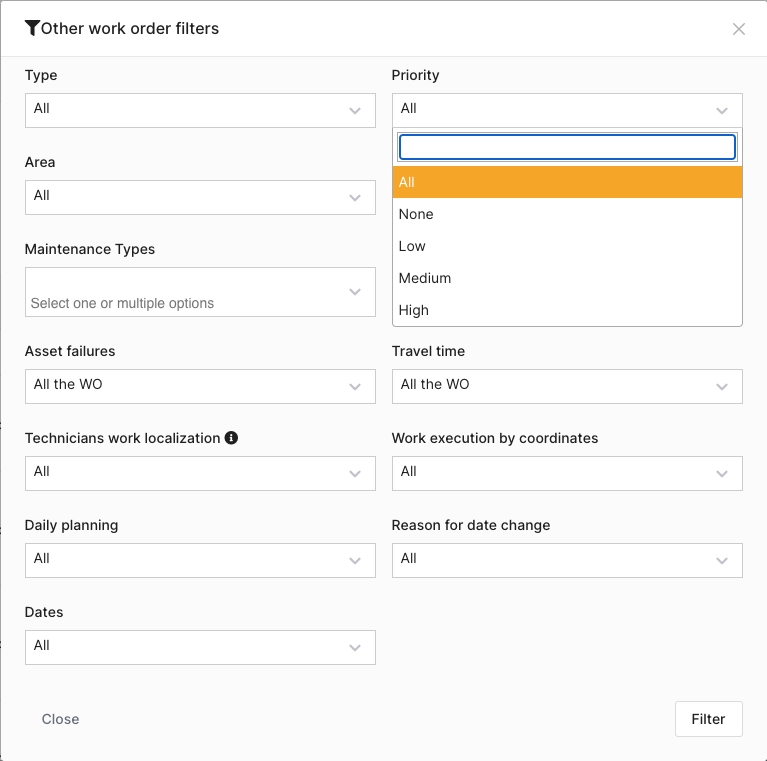
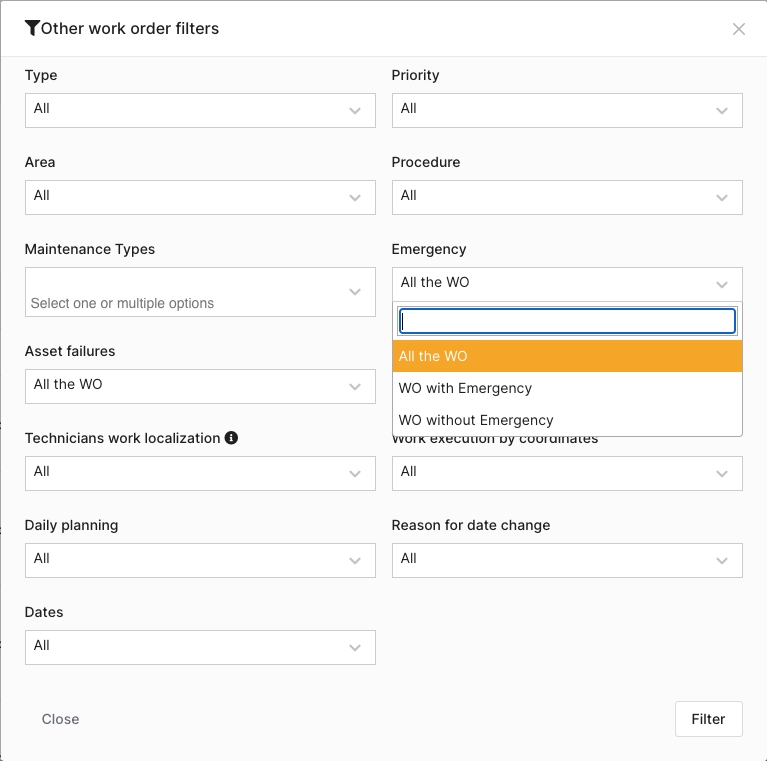
2. Advanced Key Indicators and Filters
CMMShere offers indicators such as MTBF (Mean Time Between Failures), MTTR (Mean Time to Repair) and availability, allowing the identification of critical assets and recurring tasks.
Advanced filters allow you to segment your backlog by:- Level of criticality.
- Order status (pending, in progress, completed).
- Expiration date.
- Assignee responsible.
3. Graphical display of the backlog
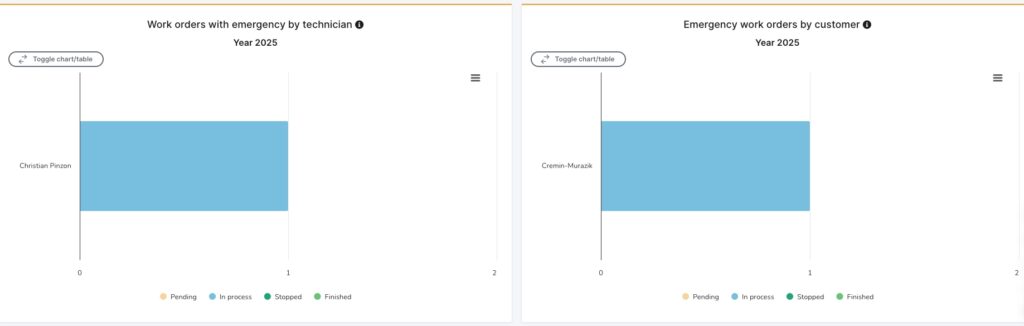
The system presents the backlog in bar graphs, risk matrices, and interactive maps, facilitating data-driven decision-making.
4. Notifications and alerts
High-risk work orders generate automatic email alerts and PUSH messages, ensuring managers act immediately.
Risk-based technical planning
Maintenance planning should consider the risk associated with each task, allocating resources and execution times based on the potential impact.
CMMShere facilitates this process by:
1. Prioritized resource allocation: The system allows technicians, tools, and spare parts to be assigned to the highest-risk tasks, ensuring that critical jobs receive preferential attention.
2. Dynamic scheduling: The scheduling of work orders is adjusted in real time according to the evolution of the backlog and the appearance of new urgent tasks.
3. Integration with the asset resume: Each work order is linked to the asset’s resume, allowing the history to be analyzed and determine if the task is recurring, if there is a history of serious failures or if the asset is near the end of its useful life.
4. Custom reports: CMMShere generates technical reports that show the distribution of the backlog by risk, the response time to critical work orders and the fulfillment of maintenance plans..
Avoiding subjectivity in prioritization
One of the biggest challenges is to avoid prioritization depending solely on the individual criteria of the planner or technician. CMMShere allows:
- Set up business rules that automatically define priority based on technical parameters.
- Record the reason for prioritization, ensuring transparency and traceability.
- Periodically audit the distribution of the backlog and adjust the criteria according to the evolution of the operation.
Practical example
If a technician reports an anomaly in a critical asset, the system generates a work order with high priority, assigning resources and alerting those responsible.
If the anomaly occurs on a secondary asset, the priority is assigned as medium or low, allowing the task to be scheduled based on availability.
Backlog management: best practices
To avoid flat backlogging and ensure efficient management, it is recommended to:
1. Define technical priority criteria: Based on risk, impact, history and consequences.
2. Use the criticality matrix: Classify tasks according to the level of risk.
3. Audit the backlog periodically: Review the distribution of tasks and adjust the criteria.
4. Train the team: Ensure that everyone understands the importance of technical prioritization.
5. Update procedures: Adapt the priority criteria according to the evolution of the operation and the results obtained.
6. Leverage CMMS technology: Use filters, alerts, and reports to make data-driven decisions.
Benefits of Risk Prioritization with CMMS
- Optimization of resources: Technicians and materials are assigned to the tasks that really require them.
- Reduction of serious failures: Critical interventions are executed on time, avoiding unscheduled shutdowns.
- Improved decision-making: Decision-makers have objective data to plan and prioritize.
- Regulatory compliance: Traceability and transparency in prioritization facilitate audits and certifications.
- Increased asset reliability: By addressing the highest-risk tasks first, equipment availability and performance are improved.
Avoiding flat backlogging is essential to ensure technical, efficient and safe management of industrial maintenance.
Risk prioritization, supported by the functionalities of a CMMS such as CMMShere, allows for optimal resource allocation, reduces the risk of serious failures, and improves decision-making.
Adopting these practices is key for maintenance managers looking to optimize operation and ensure asset reliability.
Interested in delving deeper into technical backlog management and risk prioritization?
Check out other articles on our blog and find out how to optimize your processes with CMMShere.




No comment yet, add your voice below!